
13.1 – Capacitor Assessment and Safety


New to CSA 462-24 is ANNEX W – Working with Capacitors
This section is a very brief overview of the some of the key topics added about working around capacitors.
Capacitors have the ability to store electrical energy after the source power has been disconnected.
While many systems with capacitors are built with bleed resistors that automatically discharge the stored energy within a set time, these systems can sometimes fail, leaving a thermal, shock, arc flash, or arc blast hazard. Some capacitor systems might not have built-in bleed resistors. This Annex provides detailed guidance on how to properly assess the risk in working with capacitors and implement suitable controls.
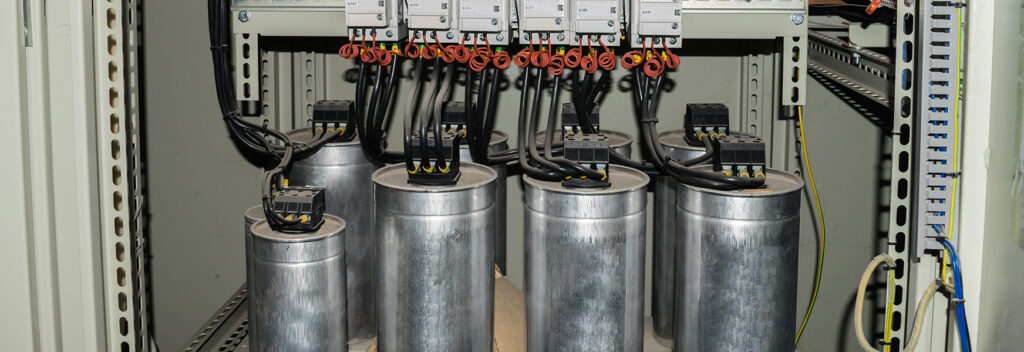
Capacitor Shock Hazard
The capacitor shock hazard to a person is an impulse shock with an exponential decay curve. The severity of the shock is related to the amount of energy (joules) delivered and the time in which the energy is delivered. Injuries from capacitor shock include severe reflex action, internal and external burns, and heart fibrillation. Reflex injury can occur at energy levels as low as 0.25 J when the capacitor voltage is over the skin breakdown threshold (about 400 V), resulting in a very rapid delivery of the energy. Reflex action can result in injuries from falling, involuntarily coming in contact with other hazards, tearing muscles, tendons, and ligaments, or dislocation of joints. Internal burn injuries to nervous system and other tissues can occur at energies as low as tens of joules. Heart fibrillation can
happen when the voltage exceeds 100 V and the stored energy delivered exceeds 10 J under certain circumstances. However, even without fibrillation, a high voltage, high-energy shock can cause serious injuries, either directly or through reflex action, down to as low as 0.25 J. Instances of temporary paralysis, loss of consciousness, hearing damage, temporary loss of eyesight, burns, and dislocated
joints have been reported.

Important Sections in the new Annex W
Special considerations for Capacitors
- Exposure to stored energy thresholds = Appropriate controls shall be applied where any of the following hazard thresholds are exceeded:
a) less than 100 V and greater than 100 J of stored energy;
b) greater than or equal to 100 V and greater than 1.0 J of stored energy; or
c) greater than or equal to 400 V and greater than 0.25 J of stored energy. - Determining the Shock Hazard = use both voltage and stored energy of the capacitor
- Determining Arc Flash = If stored energy is greater than 120 kJ, the arc flash incident energy and the arc flash boundary should be determined at the appropriate working distance. Appropriate arc flash PPE should be selected accordingly, but workers should always remain out of the arc blast lung protection boundary (defined as – worker distance at which a 1% probability of lung damage exists from a 70 kPa (10 psi) shock wave)
- Determining Arc Blast = Hearing protection should be used where the stored energy exceeds 100 J. Where the stored energy exceeds 10 kJ, the hearing protection boundary should be calculated. If stored energy is above 122 kJ, determine the arc blast boundary for lung hazards. A lung collapse hazard could exist above 122 kJ. Do not enter the lung protection boundary. There is no PPE for lung protection.

